The stone breakers
A Burial at Ornans (French: Un enterrement à Ornans, also known as A Funeral at Ornans) is a painting of –50 by Gustave Courbet. It is widely regarded as a major turning point in 19th-century French art. The painting records a funeral in Courbet's birthplace, the small town of Ornans.
A burial at ornans technique
A Burial at Ornans is an influential oil painting created by French artist Gustave Courbet between and The monumental canvas depicting a funeral outside a rural village departed radically from the prevailing conventions of the art world and is now regarded as one of the first examples of Realism in art. The painter's studio
In , when Courbet was working on A Burial from his hometown Ornans (East France), his country had just come out of a dramatic period that included the French Revolution of February and the subsequent proclamation of the so-called Second Republic, a session of harsh repressions in June , and the eventual election in December of the future Emperor Napoleon III as President of the.
Why did gustave courbet start realism
Gustave Courbet, A Burial at Ornans, begun late summer , completed , x inches, oil on canvas (Musée d’Orsay, Paris) The massive canvas of Courbet’s A Burial at Ornans still surprises viewers in the Musée d’Orsay in Paris. A Burial at Ornans is a painting of 1849–50 by Gustave Courbet. A Burial at Ornans (French: Un enterrement à Ornans, also known as A Funeral at Ornans) is a painting of 1849–50 by Gustave Courbet. It is widely regarded as a major turning point in 19th-century French art. The painting records a funeral in Courbet's birthplace, the small town of Ornans.
Gustave Courbet, A Burial At Ornans, 1849–50, oil on canvas, 314 cm × 663 cm (124 in × 261 in), Musée d'Orsay, Paris. A Burial at Ornans, influential oil painting created by French artist Gustave Courbet between 1849 and 1850. The monumental canvas (10.33 × 21.92 feet [3.15 × 6.68 meters]) depicting a funeral outside a rural village departed radically from the prevailing conventions of the art world and is now regarded as one of the first examples of Realism in art.
Bonjour monsieur courbet
Gustave Courbet is relatively unknown in when the government-sponsored art exhibition, the Paris Salon, presents his foot-long masterwork, A Burial at Ornans. The frieze-like portrayal of somber middle-class citizens at a graveside in Courbet's home province generates an explosive reaction among the painter's audience and critics. Gustave courbet realism
– Mediocre pupil at the “Petit Séminaire” at Ornans. His drawing master, “le Père Beau” makes him work from Nature. – Enters the College Royal de Besançon. Courbet has lessons from M. Flajoulot. – Courbet arrives in Paris and decides to become a painter. 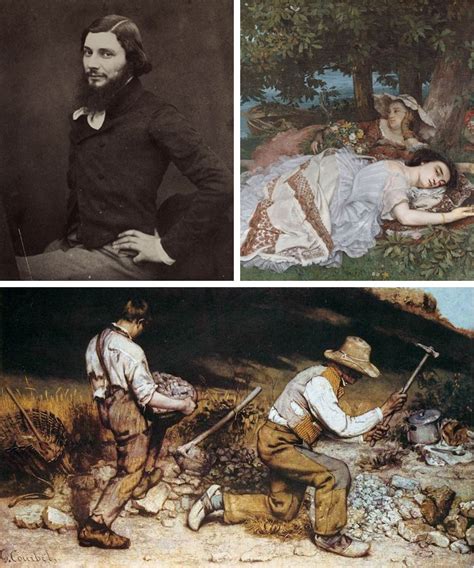 Gustave Courbet - Paintings, Biography of Gustave Courbet Gustave Courbet (born June 10, 1819, Ornans, France—died December 31, 1877, La Tour-de-Peilz, Switzerland) was a French painter and leader of the Realist movement. Courbet rebelled against the Romantic painting of his day, turning to everyday events for his subject matter.A Burial at Ornans - Gustave Courbet — Google Arts & Culture Gustave Courbet is relatively unknown in 1851 when the government-sponsored art exhibition, the Paris Salon, presents his 20-foot-long masterwork, A Burial at Ornans. The frieze-like portrayal of somber middle-class citizens at a graveside in Courbet's home province generates an explosive reaction among the painter's audience and critics.Gustave Courbet - Artistic Biography of This French Realist ... The painter, Gustave Courbet, has shown a funeral as it really was; after all, he was the man who later said that painting “can only consist in the representation of real and existing things.”[1] Taking a risk. In 1849, Gustave Courbet had left Paris and went home to the provincial town of Ornans, as he did every summer.
 The gleaners
Add a one-line explanation of what this file represents. Summary [edit]Gustave Courbet: A Burial at Ornans ; Artist.